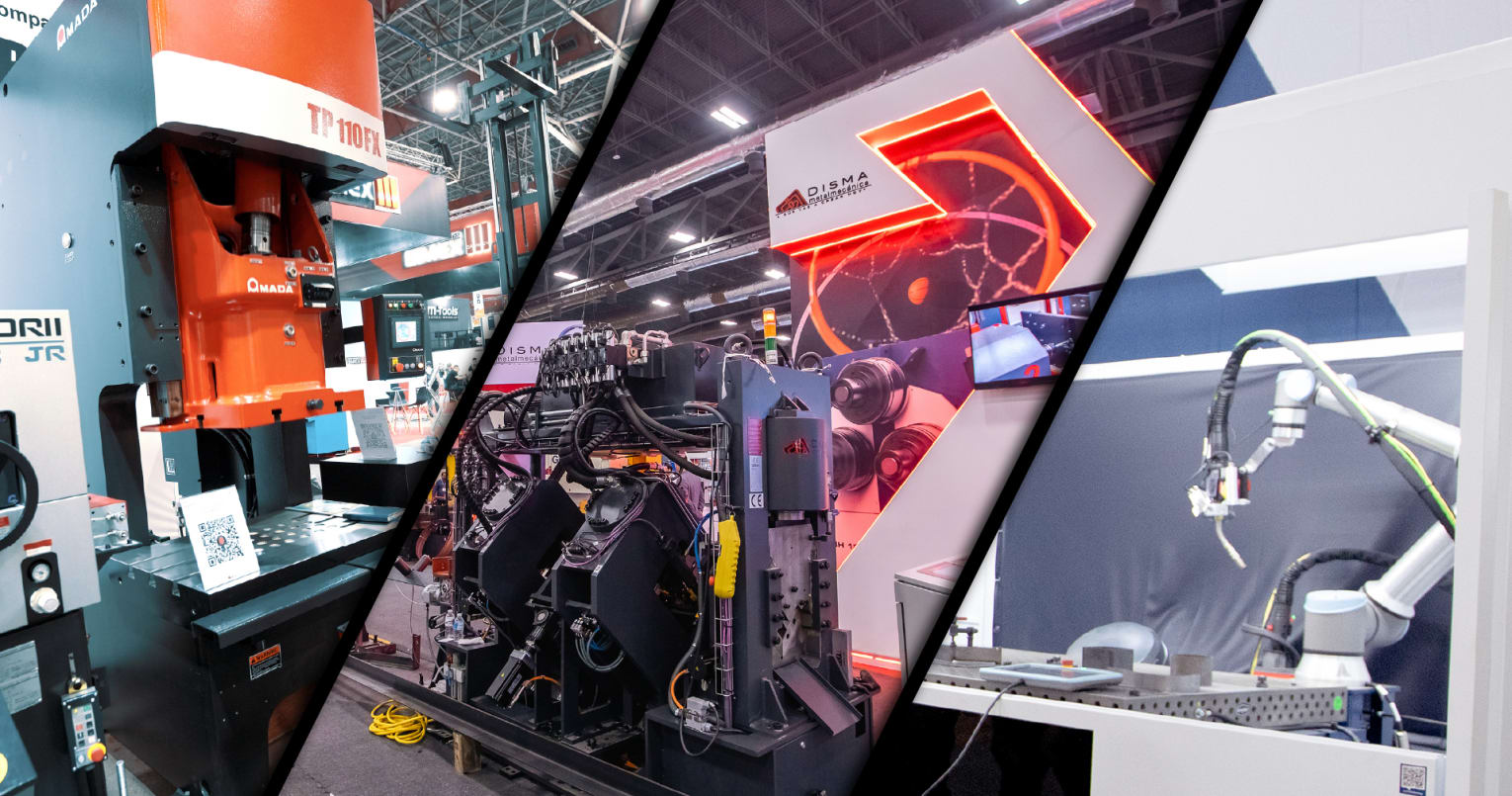
The metal forming industry is undergoing a significant transformation toward automation, driven by technologies such as machine tending, robot material handling, and digital system integration with advanced sensorization.
These technology solutions are redefining production, improving repeatability, reducing cycle times, and elevating operational efficiency.
Machine tending, or automated machine tending, has become a key solution for optimizing processes in CNC machines, milling machines, and lathes. Implementing collaborative or industrial robots in these tasks allows a constant flow of materials, freeing operators from repetitive and potentially dangerous tasks. This not only increases productivity but also improves the quality of the final product by minimizing human error.
You may be interested in: En 2025, la inteligencia artificial transformará la manufactura
Collaborative robotics has facilitated access to industrial automation processes, including machinery feeding. Robot manufacturers have developed collaborative teams that supervise and assist in manufacturing processes, feed parts to machines, and perform maintenance. Their versatility allows them to be programmed for multiple functions, increasing productivity and allowing employees to focus on higher-value-added activities.
For off-machine operations, robots are also increasingly used in automated material handling operations, commonly known as "pick and place. " These operations reduce the physical load on workers and increase efficiency. Robots can handle assembly, packaging, and palletizing tasks and operate at constant, uninterrupted speeds. This significantly decreases cycle times, increases overall production, and improves accuracy and consistency in repetitive operations.
The integration of digital systems and advanced sensorization is essential in this evolution. Solutions such as AMADA's V-factory enable real-time monitoring of production and collect data on machine status and performance, including operating times, downtime, and energy consumption.
This information is accessible from anywhere, making it easier to make informed decisions and identify inefficiencies. In addition, the My V-factory app offers a simple interface to visualize operational data instantly, optimizing production planning and execution.
Events such as FABTECH Mexico, which will be held from May 6 to 8 in Monterrey, Nuevo León, are essential platforms for learning about these cutting-edge technologies. The exhibition will bring together more than 1,200 leading brands in metal forming, fabrication, welding, and finishing, presenting innovative solutions shaping the future of the metalworking industry. Attendees will be able to interact with advanced machinery and automated systems that allow Mexican companies to modernize and optimize their operations.
At FABTECH Mexico, companies such as AMADA, DISMA Metalmecánica, and TRUMPF presented automation-oriented solutions for metal forming processes. For example, the Japanese firm AMADA has taken advantage of the forum to present solutions that maximize the productive capacity of its machines, from compact loading and unloading systems to high-capacity storage systems.
Germany's TRUMPF also often incorporates scalable automation solutions that cater to various production capacities. These include innovative features such as ACB Wireless and ACB Laser for accurate angle measurement on bending machines.
DISMA has used its knowledge as a multi-brand distributor to present solutions for designing automated cells. Robots such as presses or shears are widely used for feeding. This integration is carried out with products of the various brands they represent.
Automation is an increasingly important player in metal forming processes, as it significantly improves key indicators. Reducing the variability associated with manual labor increases repeatability and ensures consistently high-quality products.
Thanks to automated systems’ continuous and efficient operation, cycle times are also reduced, resulting in faster and more cost-effective production. Operational efficiency is increased by optimizing resource use and minimizing waste, which translates into greater competitiveness.