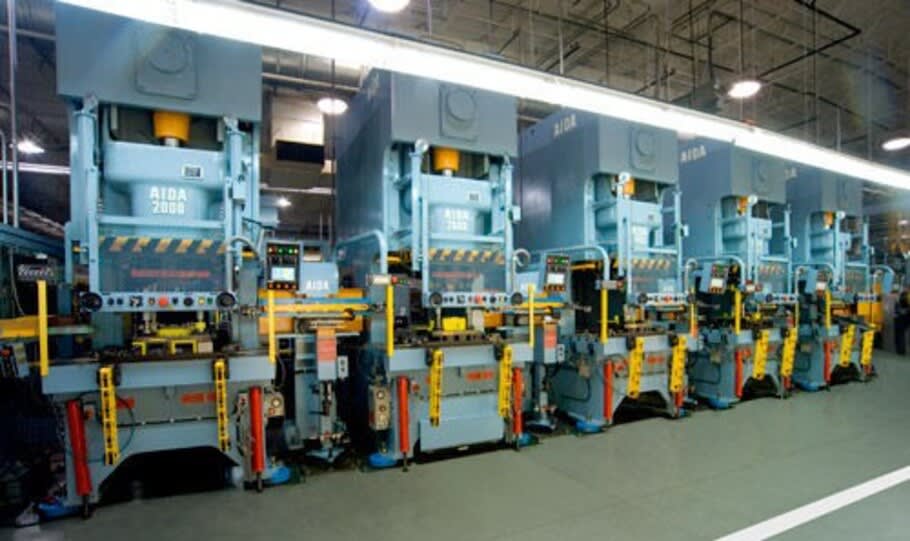
Due to their performance in metal stamping, assembly, and forming applications, servo-electric presses have grown in various industries. This equipment has gained a presence in the automotive, aerospace, electronics, and metal components manufacturing sectors. Unlike hydraulic presses, which have been widely used in processes that require constant force throughout the work cycle, servo presses offer greater flexibility in motion programming and optimize energy consumption by operating only when needed.
By employing software-controlled electric motors, servo presses allow precise speed and position control at every point of the stroke. In contrast, hydraulic presses rely on pumping systems and valves to control piston movement, which can lead to variations in pressure and affect repeatability.
Efficiency qualities
The programming of the servo presses allows the speed and acceleration to be modified at different points in the stroke, making them suitable for deep drawing, coining and high-precision stamping processes. It should be noted that in applications where constant force is required throughout the stroke, hydraulic presses remain the predominant choice.
Energy efficiency is another factor driving the adoption of servo presses. Unlike hydraulic presses, which keep their pumps running continuously to ensure immediate response, servo presses only consume energy when operating. This is the perfect analogy for hybrid cars versus internal combustion cars, as the former turn off when the vehicle is not in motion and automatically generate much greater fuel consumption efficiency.
This can reduce electricity use by up to 40% in specific processes, reducing heat generation and the need for additional cooling systems. Disposing hydraulic fluids also lowers maintenance costs and environmental risks associated with leaks or contamination.
Compelling reasons
Repeatability and accuracy are key factors in advanced manufacturing, and servo presses offer advantages. The ability to program the stroke with minimal deviations in the application of force guarantees tight tolerances in forming metal parts.
Hydraulic presses can experience variations due to changes in fluid viscosity and the wear of valves and seals, which can affect process consistency over time. On the other hand, servo presses depend on digitally controlled motors and offer precision in the loading application. This allows the quality of the final product to be optimised without constant adjustments.
The tonnage range is a noticeable difference between both types of presses. While hydraulic presses can reach forces over 10,000 tons, servo presses are generally available in capacities of up to 3,500 tons. This makes them ideal for stamping and drawing operations of medium-sized components, but less suitable for processes that require highly high forces. However, in applications where accuracy is paramount over brute force, servo presses enable better results with less material waste and less residual deformation.
Mayor control
Programming and stroke settings on servo presses allow the stroke profile to be adapted for each specific application. The ability to modify speed and acceleration at different points in the operation offers advantages in producing parts with complex geometry or thickness control requirements. In contrast, hydraulic presses rely on manual valve adjustment to modify load application times, which can lead to inconsistencies in production lines with high variability in design.
Servo presses are reduced in maintenance compared to hydraulic presses due to the absence of pressurized fluid circuits. On hydraulic presses, periodic oil changes, filter replacement, and valve checks are necessary to prevent pressure problems and leaks. Servo presses, on the other hand, primarily require verification of motors and electronic systems, which reduces downtime and costs associated with preventive and corrective maintenance.
It is important to note that the selection between servo presses and hydraulic presses depends on the type of application and the production requirements. In high-volume processes where speed and repeatability are critical factors, servo presses offer advantages in optimizing cycle time and final product quality. In applications where load capacity is the primary selection criterion, hydraulic presses remain viable, especially in manufacturing structural components and heavy-duty parts.
The growth of applications for servo presses responds to the need for greater precision and efficiency in industrial processes, which has led to their implementation in various production lines. While their adoption continues to increase, hydraulic presses play a critical role in applications where constant force is required throughout the stroke or high-strength materials are processed.
Each technology has its application field according to specific production process requirements. Servo presses' versatility makes them suitable for high-precision, energy-efficient operations, while hydraulic presses remain irreplaceable in processes where load capacity and uniform force application are critical. The evolution of both technologies will continue to define their complementarity in the manufacturing industry.