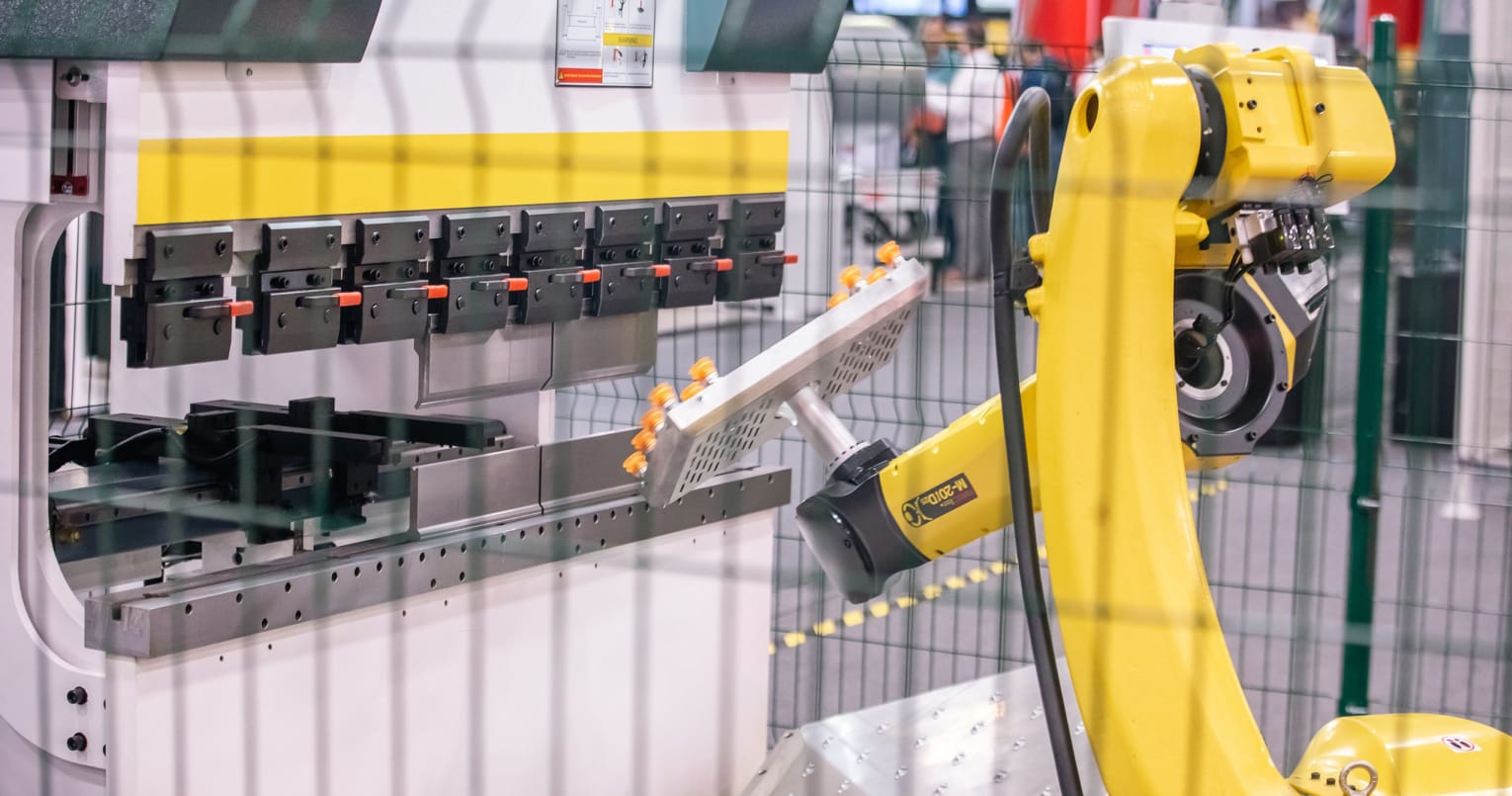
Robotic automation has transformed the metal forming industry, improving production processes’ efficiency, quality, and safety. The combination of industrial robots and collaborative robots (cobots) is expanding the capabilities of metalworking manufacturing, from welding components of all sizes to handling complex materials.
Since their introduction in the 60s, industrial robots have been a key tool in sectors such as the automotive industry. In metal forming applications, these robots excel in processes requiring speed, precision, and heavy loads. For example, industrial robots offer high repeatability when welding significant structural components such as vehicle chassis or doors and ensure precise process control.
Although they are emblematic in areas such as welding, industrial robots have proven their effectiveness for various tasks, such as material handling and process feeding. Equipped with specialized gripping systems, these robots can handle metal sheets, dies, or complex parts with weights that exceed human capabilities. This has not only reduced the risks of workplace accidents but also improved consistency in the transport and placement of materials.
A clear example is the use of industrial robots in automotive stamping lines. These automated systems handle dies and metal sheets, synchronizing movement between stations to maximize productivity. According to the International Federation of Robotics (IFR), more than 40,000 industrial robots were installed in the automotive industry globally in 2022, 23% of the global total, according to its estimates.
New players
In recent years, collaborative robots (cobots) have expanded the possibilities in the metal forming industry. Their ability to work safely alongside operators has made them an ideal choice for tasks that require flexibility and adaptation. Cobots are used in applications such as press feeding, material handling, and, in some cases, welding of smaller or custom components.
One of the main advantages of cobots is their ease of programming. With intuitive interfaces, such as touch screens or demo learning systems, cobots can be quickly configured to perform new tasks. This makes them especially useful in low-volume, high-mix productions, where frequent process changes are common.
One aspect of cobots that has been widely criticized is accuracy; however, these teams have made significant progress. Today, many cobot solutions offer up to ±0.02 mm accuracies, making them suitable for delicate tasks such as high-precision assemblies or welding on complex parts. They have also improved speed and range, allowing these solutions to be integrated into automatic feeding processes for presses or laser-cutting cells.
In the metal forming industry, cobots have gained significant traction in applications that require flexibility, secure collaboration with operators, and adaptability to process changes. One of the most common tasks where they stand out is the feeding and unloading of presses, where their compact size and advanced sensors allow them to operate in tight spaces without the need for safety barriers.
Another area where cobots have shown great utility is handling light and medium materials. They perform these tasks with high precision and care in processes that require the transfer of metal sheets or delicate parts, avoiding damage to materials and ensuring consistency in operations.
Likewise, cobots have gained popularity in precision welding by performing specific tasks on smaller or custom components, such as parts with complex geometries or low-volume projects. Their flexibility allows them to adjust quickly to different welding parameters, critical in high-mix productions.
Cobots have proven to be a valuable tool for polishing and finishing tasks. By maintaining a constant force and following complex trajectories, they achieve essential uniform finishes on parts that require high aesthetic or functional quality. In addition, they are being used more frequently in sorting and packaging metal parts, as they can identify, organize, and arrange components based on their size, shape, or position for storage or shipping.
Quality inspection is another area where cobots are adding value. Equipped with advanced vision systems or sensors, they can verify dimensions, detect defects, and analyze the surface quality of metal parts, ensuring compliance with manufacturing standards. Finally, in assembly tasks, cobots allow you to collaborate directly with operators in processes such as screwing, riveting, or adjusting components.
You may be interested in: FABTECH Mexico 2025 to face the challenge of upcoming industrial development
Cobot virtues
Their adaptability mainly explains the advancement of collaborative technology. They can be quickly programmed to perform various tasks within the same production line, making them a versatile option for businesses that handle small batches or custom parts. In addition, they represent a lower initial investment compared to industrial robots, making them accessible to small and medium-sized businesses. Integrating advanced security systems eliminates the need for physical barriers, making them easy to implement even in workshops with limited space.
Adopting cobots in these tasks improves process efficiency and quality and opens the door to greater democratization of automation. Because they tend to have a compact design, ease of use, and more affordable costs, cobots allow more companies to benefit from technological advantages in metal forming, regardless of size. This transforms the industry, making more efficient, safer, and personalized production possible.
Perfect couple
Combining these technologies offers enormous value for optimizing processes in the metal forming industry. While industrial robots focus on high-production tasks and handling significant components, cobots complement these operations in more personalized and collaborative applications.
The global industrial robotics market reached an estimated value of $42 billion in 2023, with a projected growth of 10% annually until 2030. In the case of cobots, the market is expected to grow from $1.2 billion in 2023 to more than $3.5 billion by 2030, according to reports from Mordor Intelligence.
In Mexico, robotics adoption continues to grow, driven by the need to optimize processes in the automotive, appliances, and machinery sectors. This shows a broad interest from companies in the metalworking sector investing in robotic technology.
Robotics has become a suitable option for developing more efficient and safer solutions. Industrial robots are essential for mass production and handling large parts, while cobots have opened new possibilities in collaborative and customized applications. Together, these technologies complement their capabilities and open a fascinating universe for manufacturing automation.
Two technologies, one solution
Feature | Industrial Robots | Cobots |
Velocity | High | Moderate |
Precision | Very high | Loud |
Payload | Up to several hundred kg | Generally less than 20kg |
Space Required | Wide (requires safety barriers) | Compact (no additional barriers) |
Safety | Requres strict measures | Integrated, with advanced sensors |
Flexibility | Low on frequent changes | High, ideal for low-volume lines |